Accelerating the medical wheel with AI: From engagement to impact

Many medical teams are experimenting with artificial intelligence (AI) through tactical pilots, yet, few have articulated a unified vision for what these tools mean for the function.
This article, based on interviews with global medical industry leaders, presents an AI-powered 360 Medical Engagement vision that links engagement, insight, evidence, and strategy in a continuous loop. The model accelerates the flow of information across medical functions to drive credible and customer-centric scientific exchange that helps improve clinical decisions and clinical practice.
Jan Deman from Takeda describes opportunity perfectly: “Treat Medical as a rolling wheel, which we start with the global Medical Strategy feeding the scientific evidence generation. These are being validated through the engagement and insights collected to feed back to the strategy so that clinical practice steadily moves forward.”1
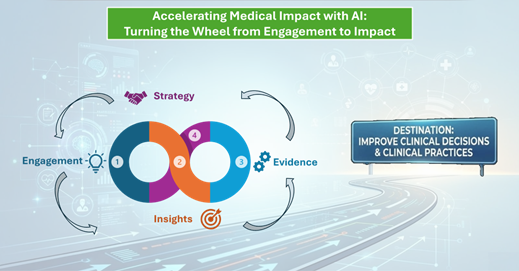
The 360 Medical Engagement model is an “Outside-In” pull-based approach to reflect a modern, customer-centric operating model.
Accelerating the medical wheel
The wheel consists of four segments moving the organisation from product-push to a customer-centric rhythm. Engagement generates the Insights that inform our understanding of clinical reality. These insights refine our Evidence library, the repository of approved data and scientific narratives used for exchange which is continuously reconciled with field insights. This reconciliation continually informs our Strategy, as the next turn of the wheel.
While Global Strategy sets the initial direction, true agility is sustained through a 360-degree loop that prioritises real-time Evidence and Strategy adjustments based on active field signals. To realise this, organisations must evolve from traditional Inside-Out (Push) systems and a fluid Outside-In (Pull) 360 model.
Traditional push models cascade priorities from the top down, often creating a slow “broadcast” culture limited by internal planning cycles. In contrast, the Pull approach treats every field engagement as a strategic sensor. By starting with Engagement and Insight, the organisation “pulls” the most relevant data to respond to real-world needs. AI is the critical accelerant here; while humans struggle to reconcile thousands of field signals with vast databases, AI agents automate this mapping instantly to ensure the wheel is powered by external clinical reality.
The reality gap: Today’s friction vs tomorrow’s flow
“Frameworks exist, but disciplined execution is the real test.” —Roy Palmer, Vertex2
Most Medical leaders already have the right intent. They want an engagement-focused approach with strong insight capture that is validated by evidence and followed through into strategy. However, the challenge is disciplined execution across Medical Affairs functions. Information travels slowly through disconnected systems and silos, causing valuable signals from the field to get diluted across slide decks and email threads.
AI acts as the engine that helps the Medical wheel roll faster by removing the repetitive work that slows teams down. In this model, humans remain accountable for scientific judgement and decisions while AI agents reduce operational friction. Engagement, insight, evidence, and strategy operate as a connected system with clear ownership and cadence so that learning compounds and follow-through becomes reliable.
To achieve this speed, the model proposes three primary AI agents that handle the heavy lifting of data processing while keeping medical experts in control of every scientific decision:
| Insight Agent | Standardises fragmented field notes and voice memos into structured data. It identifies core scientific questions and HCP needs, ensuring every signal is captured in a consistent, searchable format. |
| Synthesis Agent | Acts as the analytical engine, mapping insights against the evidence library and current strategic priorities. It groups observations into themes to highlight evidence gaps while providing Medical Leadership with data-driven recommendations to validate or pivot the strategy based on real-world feedback. |
| Content Agent | Automates execution by drafting updates to modular content and field guidance based on approved themes. It ensures teams have relevant, approved content ready for their next engagement. |
“Publication and evidence strategies work only when they start from real unmet Medical needs. AI will be the one of the most important companion to identify the real ones.” —Zafer Mavioglu, Alexion3
Imagine the flow: A congress scenario
A major medical congress provides the clearest evidence of how the 360 loop accelerates intelligence. Traditionally, synthesising congress observations takes weeks of manual effort. In the 360 model, this process is condensed into days.
- When a Medical team walks out of a congress hall on a Friday afternoon, they often carry dozens of information fragments. In the 360 Medical Engagement model, the synthesis of this information begins before the team even boards their flights home.
- Medical leads record key moments immediately using a simple note format that captures the specific HCP question and the scientific takeaway in real-time. Over the weekend, the Insight Agent structures these inputs while the Synthesis Agent maps them against the evidence base.
- By Monday morning, AI has grouped signals into established versus emerging themes, and provides strategic actions. Leadership bypasses manual data sorting to focus entirely on strategic decision-making.
- Once priority themes are confirmed, the Content Agent is approved to automatically draft specific updates for modular content, FAQs, and field guidance.
- By midweek, approved content is published to the library. MSLs receive briefs connecting congress signals to updated storylines for immediate expert follow-up.
- Within days, the Medical wheel completes a full turn, transitioning the function from raw observation to actionable scientific guidance at unprecedented speed.
The transition to an automated loop does not replace the need for expert oversight, but instead allows the team to focus on high value scientific exchange, rather than manual administration.
Operationalising the Loop: How it works
Establishing AI requires more than technical integration; it demands clear agent roles enabled by Medical Operations, but approved by Medical Leadership. Success relies on three core elements:
- The rhythm of strategic review
Strategy must shift from an annual event to a repeatable cadence. Using fixed regular checkpoints from weeks to quarters depending on the TA portfolio maturity levels allows teams to adapt their strategy in a controlled, evidence-led way, rather than constantly restarting the planning process.
- Defined collaboration
Successful 360-model execution requires seamless orchestration between Medical and other client-facing functions. While Medical independence is non-negotiable, strategic coordination is essential to ensure that insights gathered across the organisation lead to a unified understanding of the stakeholder. In this accelerated model, collaboration is defined by shared visibility into the "gaps" identified by AI agents, such as unmet educational needs or evidence contradictions allowing each function to respond within its own compliant remit. By defining these collaboration boundaries in advance, teams move away from siloed activity toward a coordinated, customer-centric presence.
- The enabling foundations
Sustainability comes from simplicity. Organisations must integrate AI agents alongside a minimal data backbone and a single source of truth. This ensures raw signals are immediately structured and mapped to the evidence base in real-time.
“Tools are successful only when they simplify work and save time for customer facing colleagues on field and content owners.” —Shaantanu Donde, Viatris5
Implementation: Start narrow to scale
Realising this vision requires focused execution, rather than broad redesign. Organisations should start small, running two disciplined cycles to prove value. Initial use cases should be high-frequency, such as post-congress activation or KOL scientific exchange loops.
The first cycle establishes the end-to-end process, while the second cycle refines it during a comparable event to confirm the approach is faster and more reliable. Successfully repeatable practices should then be packaged into a playbook for broader rollout.
Measuring success: Meaning over volume
A successful 360-degree model is measured by its impact on organisational learning, rather than simple activity counts. The primary goal is to prove the loop is shaping scientific exchange in meaningful ways. KPIs include:
- Adoption: Consistent use of new ways of working across the organisation.
- Engagement quality: Assessing if interactions are increasingly addressing priority scientific questions.
- Insight activation: Measuring the cycle time from initial capture to tangible strategic decisions.
- Scientific influence: Observing changes in expert enquiries and alignment between field discussions and evolving evidence.
“Keep the focus on scientific questions and simple operating rhythms so teams can learn every cycle.” —Egemen Ozbilgili, Pfizer6
Moving towards a 360 future
The transition toward a 360 Medical Engagement model represents a fundamental shift in the operating story of the function. The competitive advantage comes from how reliably an organisation converts engagement into insight, validates it against evidence, and informs a dynamic strategy.
Agentic AI is the tool for speed and scale, but scientific judgement and ethical responsibility remain human. AI removes repetitive tasks, but it must not replace medical interpretation.
Teams that treat this as an operating model evolution, rather than a technology rollout, will be best positioned to sustain scientific impact and drive better outcomes for patients.
Disclaimer: This article synthesises cross-industry lessons learned and does not describe proprietary processes, internal data, or company confidential operating details. Contributor perspectives reflect individual experience and do not represent the official views of their employers.
About the authors

Osman Daggesen if digital transformation consultant at The Stem.

Gregg Fisher is founder and managing director at The Stem.
Contributor Attributions
- [1] Jan Deman, VP & Global Head Medical Data Digital & Technology, Takeda
- [2] Roy Palmer, Digital Medical Affairs and Analytics Global Lead, Vertex
- [3] Zafer Mavioglu, Global Medical Capabilities, Associate Director, Alexion
- [4] Neha Shah, Senior Director, Medical Affairs and Chief Patient Office Technology, Vertex
- [5] Shaantanu Donde, VP, Head of Global Growth & Strategy Team - Medical Affairs, Viatris
- [6] Egemen Ozbilgili, VP, Asia Medical Affairs Lead | Emerging Markets, Pfizer